Why “around the corner” is the hardest moment
You’ve felt the hardest moment even in a normal car: creeping toward an intersection where a building blocks cross traffic, edging past a row of parked SUVs, or rounding a tight curve on a two-lane road. For a self-driving system, that “around the corner” instant compresses risk into a small slice of time, because there’s little warning and not much room to brake or steer if something appears suddenly.
Occlusions don’t just hide objects; they hide the timing of when an object will become visible. A pedestrian can step out from behind a delivery van, a cyclist can emerge from a blind driveway, or a fast car can arrive at the edge of sight with a speed that makes right-of-way irrelevant. The system has to choose between moving efficiently and leaving enough margin for what it can’t confirm yet, and that margin costs time, comfort, and sometimes traffic flow.
What occlusions really hide: objects, intent, and timing
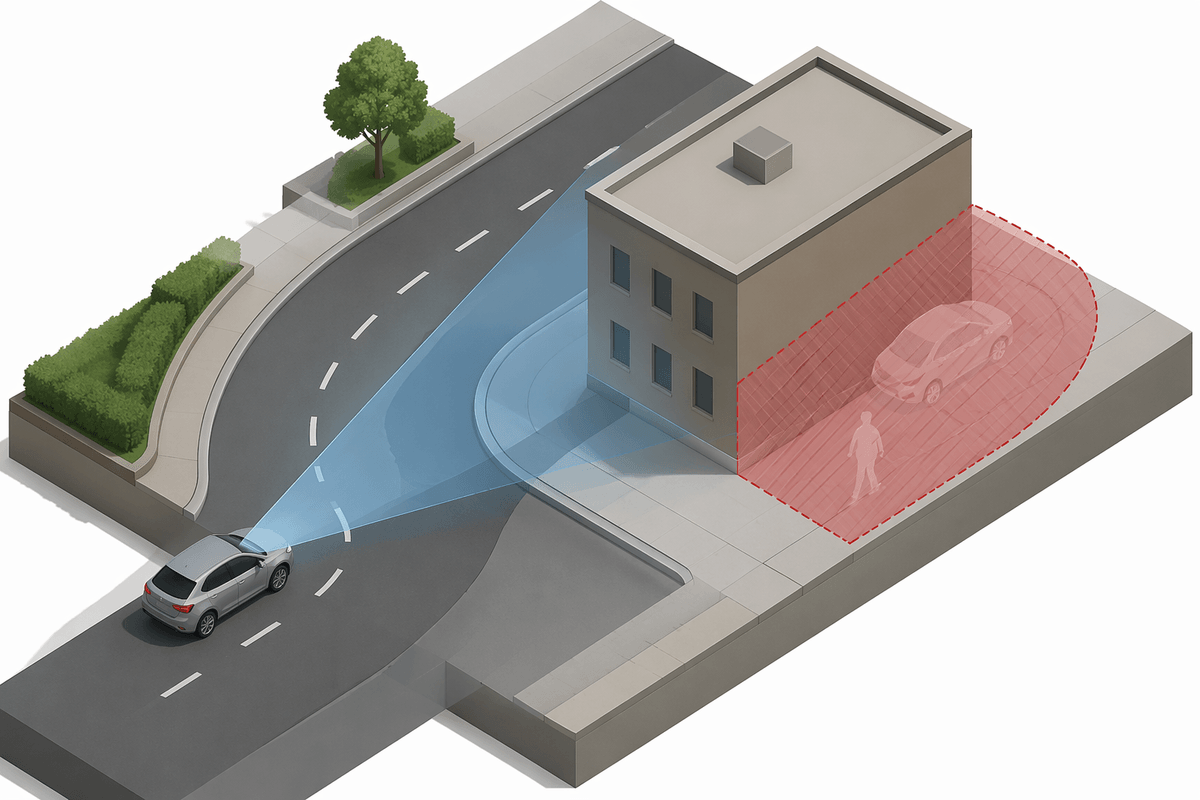
When people say “seeing around corners,” it’s easy to imagine a single missing thing: the hidden car or pedestrian. In practice, occlusion removes three pieces of information at once. First is the object itself (is there anything there?). Second is intent (is the cyclist slowing to turn, or accelerating into the lane?). Third is timing (when will they enter the drivable space, and how fast will the situation change?). Those last two matter because the safest response is often decided before the object is fully visible.
Autonomy stacks uncertainty in these zones: an empty-looking crosswalk could still contain a person about to step out, and a “clear” curve could hide a vehicle already committed to your lane. Systems compensate with conservative assumptions, slower approach speeds, and “keep-out” regions that treat the occluded area as potentially occupied. The extra hesitation can create annoying gaps, rear-end risk from human drivers, and longer trip times, especially in dense city traffic.
Sensors that help before you add any new infrastructure
Pull up to a blind intersection and the first improvement usually comes from using the sensors already on the vehicle more intelligently, not from adding roadside gear. Cameras provide rich cues—crosswalk markings, wheel motion, a pedestrian’s posture—but they fail hardest when the view is blocked or lighting is harsh. Radar helps earlier in the approach because it can detect and track motion at longer range and in rain, fog, or glare, and it can sometimes register a vehicle that’s mostly hidden except for a reflective edge. Lidar adds precise geometry for the parts of the scene it can see, which tightens braking distance estimates and reduces “phantom” uncertainty from shadows or texture.
In practice, “around the corner” driving is often a sensor-fusion problem plus a planning problem. If radar suggests fast cross traffic but the camera can’t confirm, the system may slow sooner to buy time. If lidar confirms an empty near-field but the far side is occluded, it may creep with a strict speed cap. The limitation is cost and packaging—high-performance lidar and imaging radar raise bill-of-materials and power—and none of these sensors can reliably identify what’s fully behind a solid wall without other methods.
Seeing without line-of-sight: NLOS and “bouncing” signals
On some streets, the most useful signal isn’t the one that comes straight back. Radar waves can reflect off building faces, trucks, or even the road surface, creating “multipath” returns that carry hints about motion hidden from direct view. Researchers call this non-line-of-sight (NLOS) sensing: you’re not imaging the object the way a camera would, you’re inferring it from how energy bounces through the scene. In the best cases, the system can detect that something large is moving across the far side of an intersection before it would be visible in the forward camera.
A reflection can look like it came from a different position, or split into several ghost targets, and the pattern can change as the ego vehicle creeps forward by a meter. That means NLOS tends to be better at early warning (“something is coming”) than crisp localization (“it will be exactly here in 1.2 seconds”), and it can be brittle in cluttered urban canyons. It also demands heavier compute and careful calibration, and performance varies with materials, angles, and the presence of good reflectors.
Cooperative perception: cars and streets sharing what they see
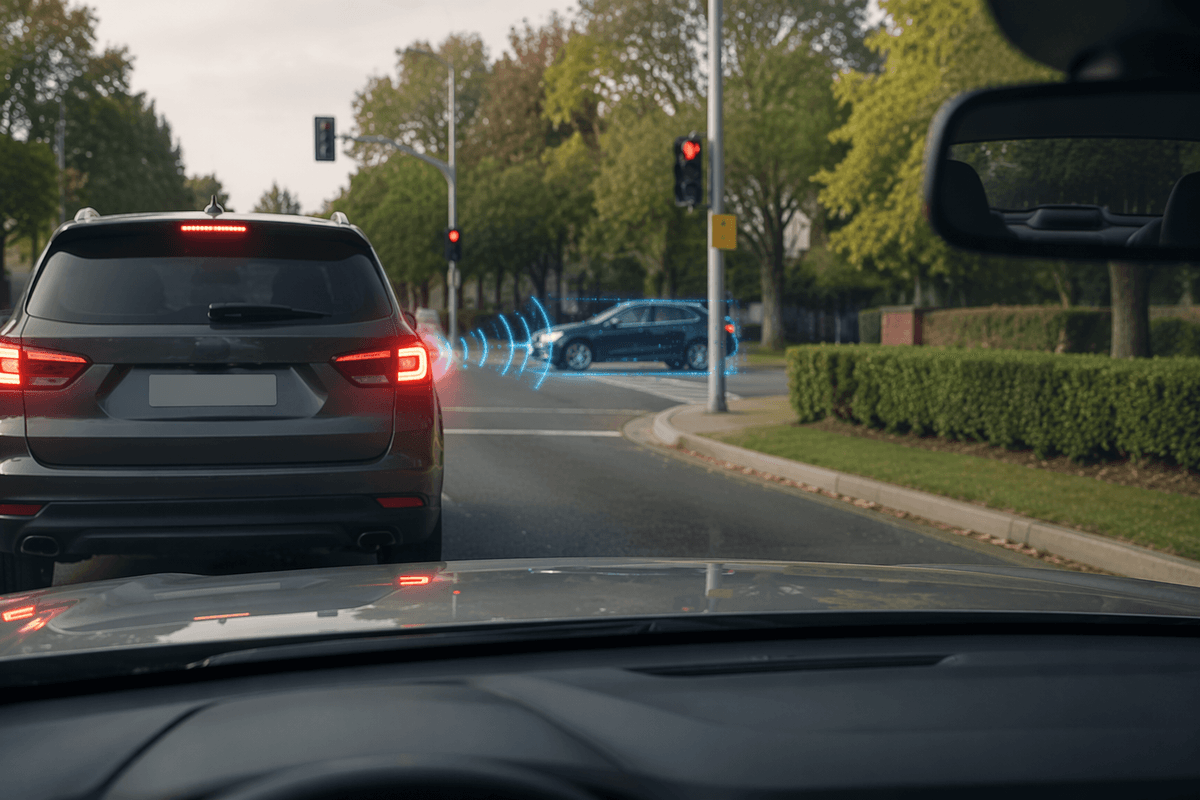
A familiar workaround to a blind corner is to “borrow” someone else’s view: a human driver reads the motion of the car ahead, or waits for a pedestrian to glance into the street. Cooperative perception formalizes that idea by letting vehicles and infrastructure share what their sensors already detect. A car that can see cross traffic can broadcast an object list (position, speed, classification, confidence), and a roadside unit at an intersection can do the same from a higher vantage point. Compared with raw camera video, these compact messages can travel with lower bandwidth and less privacy risk, and they can extend awareness beyond any single vehicle’s line-of-sight.
Latency and time sync matter: a 150 ms delay can turn “safe gap” into “hard brake” at urban speeds. Coverage is uneven; cooperative perception works best where many vehicles speak the same V2X dialect and where intersections have power, backhaul, maintenance budgets, and secure key management. Fusion is also non-trivial: if the roadside unit reports a cyclist but the car’s own sensors disagree, the software needs rules for trust, de-duplication, and graceful fallback rather than assuming the shared view is always correct.
Software that behaves safely even when it can’t see
Watch how a careful human handles a truly blind corner: they don’t “solve” the occlusion, they manage exposure. Safe autonomy software has to do the same, treating the hidden region as a risk budget problem—how much time and distance the car is willing to “spend” before it has confirmation. Practically, that shows up as explicit approach-speed caps, creep behaviors, and trajectory choices that keep the car in positions where a sudden hazard still leaves a viable brake-and-yield option. The planner isn’t just optimizing comfort; it’s enforcing that, even if something enters from the occluded area at a plausible speed, the outcome stays within a defined safety envelope.
This is where prediction and “unknown object” handling matter more than glossy perception demos. The system maintains hypotheses—someone could step out, a vehicle could be cutting across—and picks actions that are safe across those scenarios, not just the most likely one. The conservative envelopes create hesitation, invite cut-ins, and can trigger rear-end risk from impatient human drivers. And the software must fail gracefully when upstream inputs degrade—dropping cooperative messages, inconsistent NLOS radar echoes, or a temporarily blinded camera—by reverting to a slower, simpler policy rather than trying to “average” uncertainty into confidence.
What it takes to prove it works in the real world
The proof problem shows up the moment you ask a concrete question: how often does this system detect a hidden hazard early enough to avoid hard braking, and how often does it “see” ghosts and slow traffic for no reason? Real validation means measuring time-to-detect and time-to-react across thousands of occluded scenarios—delivery vans at crosswalks, offset intersections, rainy nights—then showing the planner still stays within a safety envelope when sensors disagree or shared V2X messages arrive late.
You need curated corner-case data, repeatable test tracks, simulation that matches sensor physics well enough to trust NLOS and multipath effects, and on-road trials with tight safety-driver procedures. The bar isn’t a single impressive demo; it’s stable behavior under distribution shift: new cities, new building materials, different traffic cultures, and months of sensor aging without the risk curve quietly drifting upward.