Why designing proteins from scratch suddenly matters now
A familiar pattern in biotech is spending months tweaking a protein that evolution already handed you—then hitting a wall because the “starting scaffold” can’t do the job, or can’t be manufactured, stabilized, or made selective enough. That is why designing proteins from scratch matters: it replaces incremental patching with the option to propose entirely new starting points.
It matters now because structural biology and compute have reached a threshold where models can explore huge design spaces quickly, while downstream platforms (DNA synthesis, high-throughput screening, and modalities like mRNA) can turn digital candidates into physical tests faster than before.
The constraint is still brutal: most designs fail when they meet real chemistry, and validating them requires specialized labs, expensive assays, and time—so “design” is only the opening bet, not the proof.
From sequences to shapes: what counts as a “new structure”
A protein “design” starts as a sequence—a string of amino acids—but what usually matters is the 3D shape that sequence reliably folds into, because shape controls binding, catalysis, and stability. When headlines say “new protein structure,” they can mean very different things: a minor variant of a known fold, a known fold with a new surface geometry that changes function, or a genuinely new topology (a new arrangement of helices and sheets that isn’t found in structural databases).
Novelty is rarely binary. Two designs can share the same overall fold yet behave like different products because small geometric shifts change pockets, charge patterns, or flexibility. At the same time, claiming a “new structure” based only on a model prediction is premature; the practical standard is whether the molecule folds as intended and stays folded under real conditions (temperature, salt, crowding). Measuring that takes experiments, and experiments are slower than generating sequences.
How generative models propose protein blueprints, not finished products
A common demo shows a model “inventing” a protein in seconds, but what it really produces is a blueprint: a proposed sequence (and sometimes a target 3D backbone) that might fold into a useful shape. Generative models learn statistical regularities from known proteins—what amino acids tend to appear in helices versus sheets, how packing patterns repeat, which motifs correlate with binding surfaces—and then sample new combinations that look plausible under that learned distribution.
That output is not a finished therapeutic or enzyme. It usually lacks the surrounding decisions that make a molecule workable: where to place a catalytic residue, how to tune flexibility, how to avoid aggregation, how to ensure it expresses in cells, and how to keep it stable at manufacturing temperatures. Even when a model predicts a clean structure, small errors in packing or charge can turn a “great-looking” design into something that misfolds or sticks to itself.
In practice, teams treat the model like an idea generator that can draft thousands of candidates, then rely on filters, expert review, and experiments to find the few that behave as designed.
Keeping designs realistic: constraints that force physics to agree
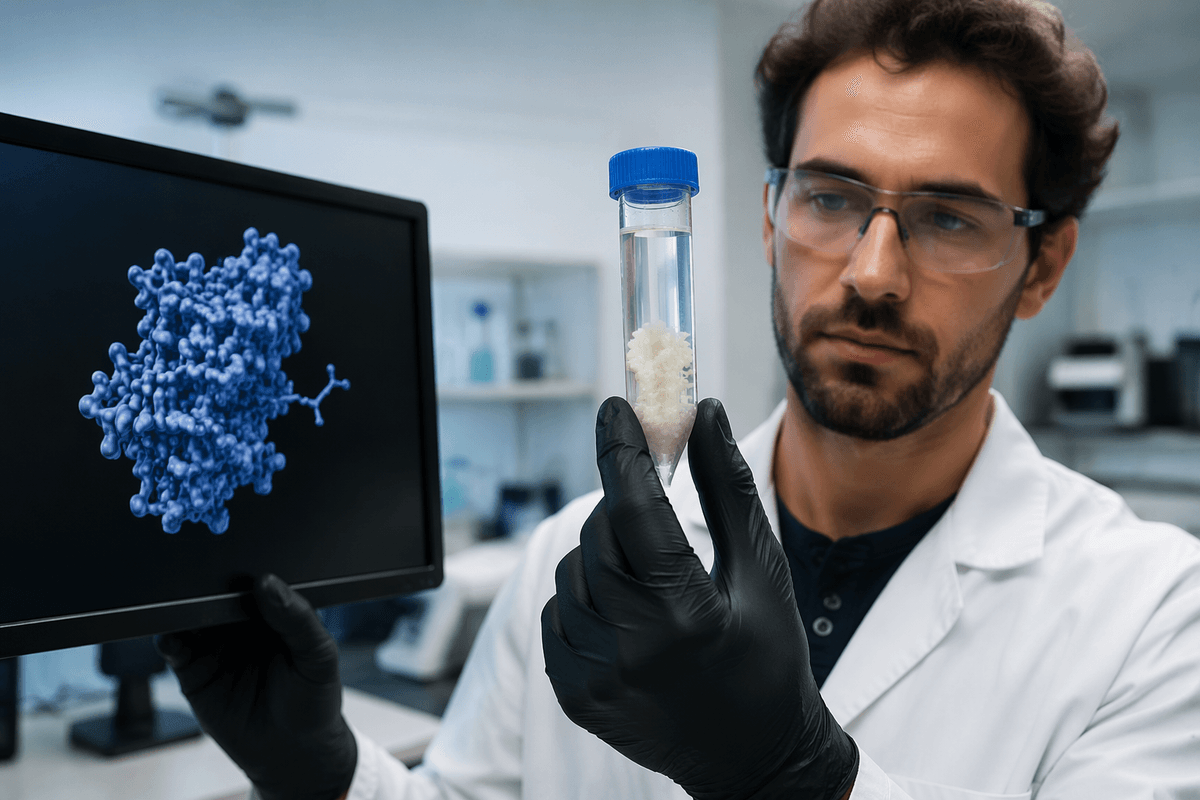
A recognizable failure mode is a design that looks clean on a screen but falls apart in a tube: it aggregates, refuses to express, or unfolds when salt, temperature, and time vary. The fix is not “more creativity,” but adding constraints that force the proposal to satisfy basic physics and biochemistry.
Teams bake in these constraints at several layers. Geometry constraints keep bond lengths, angles, and steric clashes reasonable, and penalize cavities or poor packing that would destabilize the core. Electrostatics and solubility heuristics discourage large exposed hydrophobic patches and extreme net charge that can drive sticking or precipitation. Sequence-level rules avoid motifs that trigger misfolding, unwanted disulfides, or problematic glycosylation when expressing in common systems.
Then come “reality checks” that act like adversarial tests: independent structure predictors to see if the sequence still folds to the intended backbone, molecular simulations for flexibility, and negative design to reduce binding to off-target shapes. Every added constraint shrinks the search space and can reduce novelty, and it also raises compute and human review costs—one reason why promising designs still arrive in the lab as a small, carefully filtered set.
Choosing your target: enzymes, binders, materials, or switches
The most practical choice is not “can we design a protein,” but “what kind of protein gives you a clean readout and a believable path to value.” Enzymes promise big upside—turning cheap inputs into valuable products or hitting hard drug targets—but catalysis is unforgiving. You must place a few residues in exactly the right geometry, manage water and proton transfers, and keep the active site stable across temperatures and solvents. Many “working” designs show activity that is real but far below industrial or therapeutic relevance, so timelines often include several rounds of lab evolution.
Binders are typically the near-term winner. If you can create a surface that sticks tightly and selectively to a target (a cytokine, receptor, viral protein), you can measure binding quickly and then iterate. Even then, you still have to solve developability: expression yield, aggregation risk, immunogenicity screening, and whether the binder blocks the right functional epitope.
Materials and switches sit in between. Self-assembling cages, fibers, or hydrogels can tolerate more structural variation, but manufacturing and consistency are hard. Switches—proteins that change behavior with pH, light, or a small molecule—often work first as sensors or research tools before they earn their way into medicines.
Proof it works: ranking in silico, then testing in wet labs
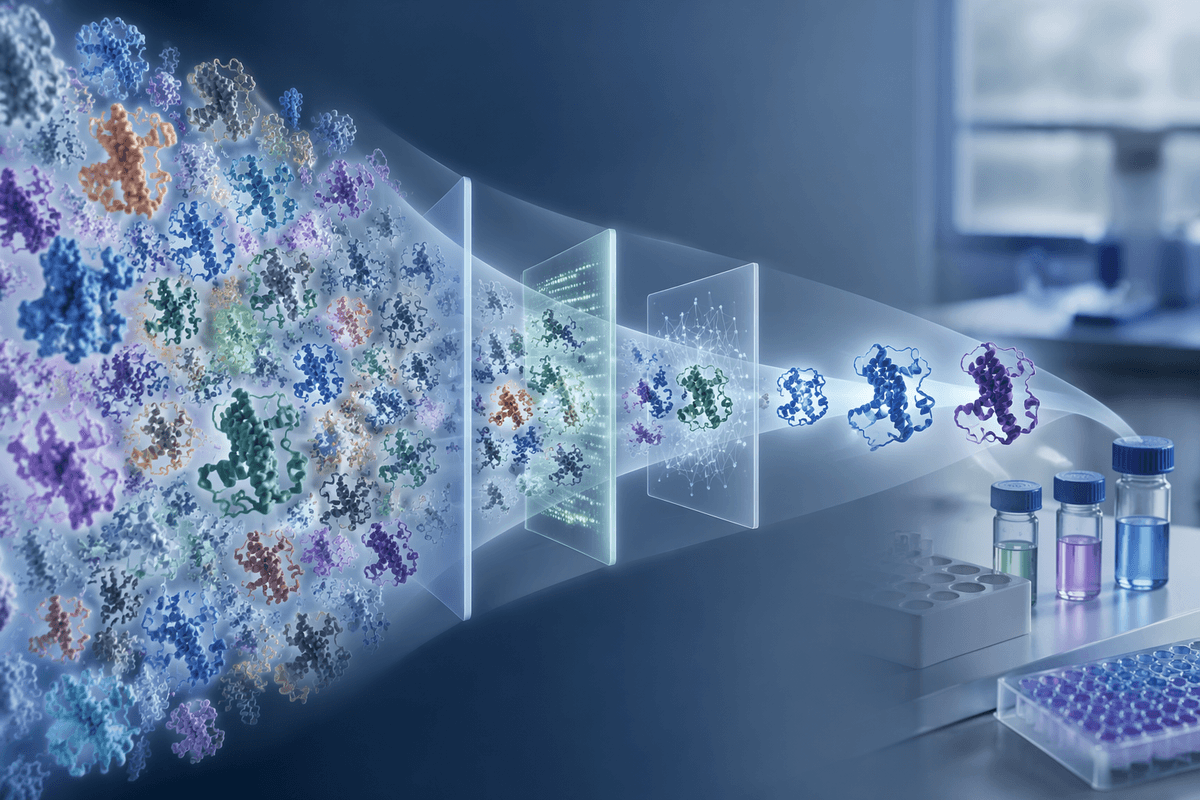
A typical workflow starts with an uncomfortable number: thousands to millions of candidate sequences that “look” like they might fold and function, but only a handful can be built and tested. Ranking in silico is the triage step. Teams score candidates on predicted folding confidence and stability, then add practical filters like sequence diversity (to avoid testing near-duplicates), expression likelihood, solubility/aggregation risk, and whether the designed surface actually presents the intended pocket or epitope. For binders, docking-style checks and interface metrics help, but they are noisy; for enzymes, models can suggest active-site geometry yet still miss the subtle placement needed for real turnover.
Wet-lab validation is where hype collapses into numbers. The first pass is usually “does it exist as a well-behaved protein”: can it be expressed, purified, and stay soluble, with evidence of the intended fold (often via biophysical assays and, for the best hits, structural determination). Only then do functional assays matter—binding affinity and selectivity, or catalytic rates under realistic conditions. The practical constraint is throughput: assays, controls, and quality checks cost money and weeks, so the most credible results show not one hero design, but a hit rate and a repeatable loop for improving it.
Limits, risks, and what progress will look like next
A familiar pattern in AI protein design is a great-looking structure paired with weak real-world behavior: low expression, instability in formulation buffers, or binding that vanishes in serum. The bottleneck is still experiments, and the honest metric is yield-adjusted hit rate per design-test cycle, not a single headline-grabbing molecule.
Risks are practical and biological. Lab safety and dual-use concerns rise as design tools spread, while clinical risks show up as immunogenicity, off-target binding, and manufacturing variability that models do not reliably predict yet. Progress will look less like “one model solves biology” and more like tighter closed loops: standardized assays, better uncertainty estimates, and datasets that connect sequences to failures, not just successes.