Why seaweed needs protection—and why timing matters
Seaweed forests and farms do quiet infrastructure work along coasts: they buffer waves, create habitat, and support local economies. But they can also fail quickly. A few days of unusually warm water, a burst of poor water quality, or a grazing event can tip healthy beds into rapid thinning, and by the time divers or crews notice, the window for action may have passed.
Timing matters because many responses are only useful early. Farms can adjust harvest schedules, move lines, change depths, or pause seeding; managers can target inspections, limit stressors, or prioritize protection of the most resilient patches. Machine learning is most valuable when it turns scattered observations—temperature logs, satellite color changes, simple field notes—into a clear “check this now” signal. Those signals depend on consistent, local data and can still produce costly false alarms.
The real threats: heatwaves, disease, grazing, and pollution
Most seaweed losses trace back to a few stressors that compound each other. Marine heatwaves push kelp and other canopy-formers past their thermal limits, reducing growth and making tissue easier for pathogens to exploit. Disease outbreaks can follow, showing up as bleaching, lesions, or weakening holdfasts—subtle at first, then suddenly widespread. Grazers add a different kind of pressure: urchins can clear whole patches, while smaller herbivores can “sandpaper” fronds until storms finish the damage.
Pollution and runoff often act as multipliers. Nutrient pulses can fuel blooms that shade seaweed or swing oxygen levels at night; sediment can smother recruits and reduce light; certain contaminants can slow growth even when plants look intact. The same thinning pattern might be heat stress, grazing, or turbidity. That’s why ML systems usually need a mix of local temperature, water-quality signals, and periodic visual checks to avoid confident but wrong diagnoses.
What data can actually “see” seaweed health
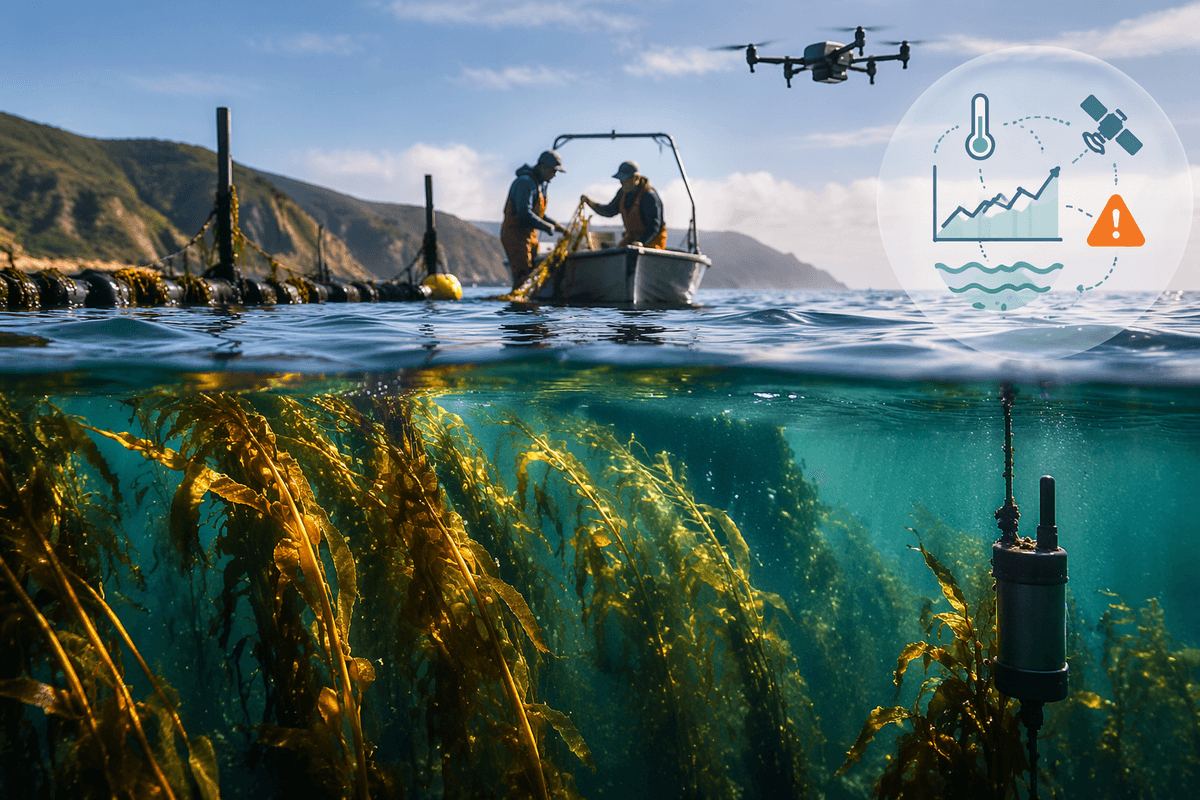
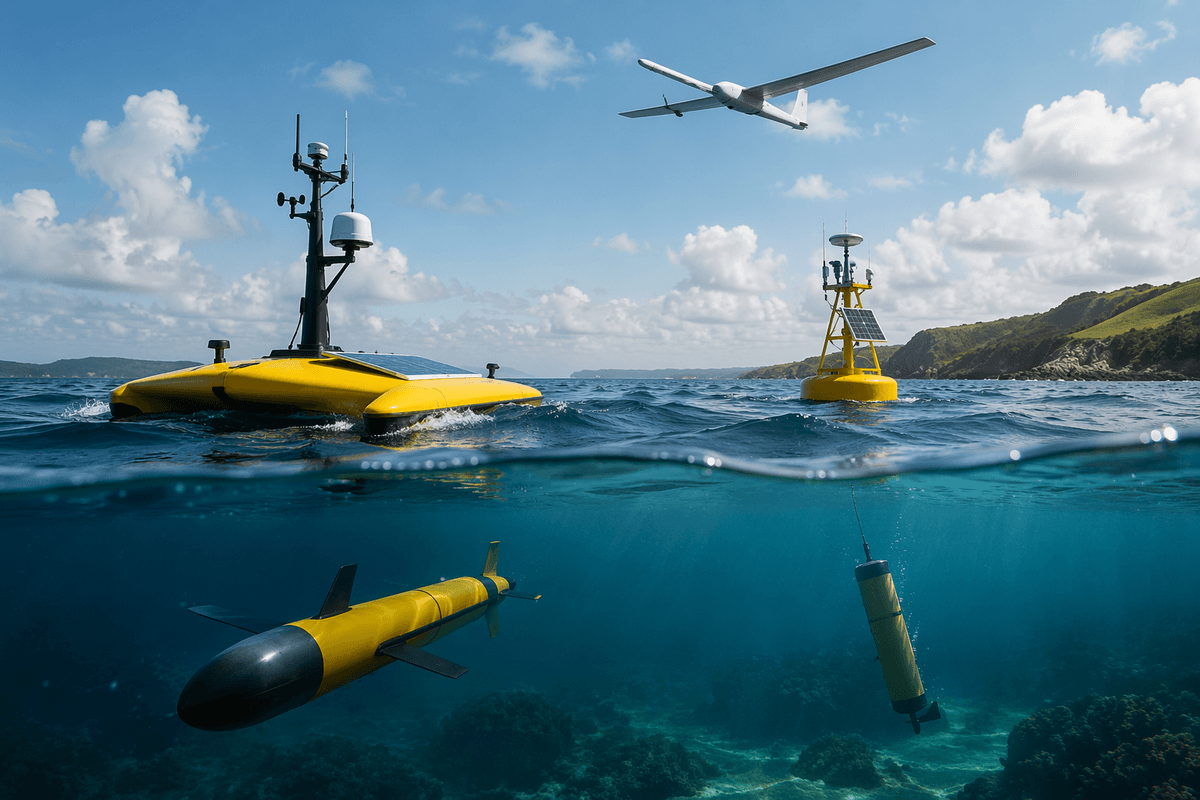
A farm manager usually knows something is wrong before they know what is wrong: yields drop, lines foul faster, fronds look paler, or break more easily. Data that can “see” seaweed health tends to fall into three buckets: images, water conditions, and ground truth. Images come from satellites (good for broad canopy changes), drones or boat surveys (better detail), and underwater cameras (best for lesions, grazing, and biofouling). Water-condition data comes from temperature loggers, oxygen, turbidity, salinity, and sometimes nutrients—signals that often shift before visible damage.
Each data source has blind spots. Satellites miss what’s underwater and can be blocked by clouds or tannin-stained water; drones need permits, pilots, and calm weather; underwater cameras require power, cleaning, and stable mounting. Sensors drift and foul, so maintenance is a real cost. ML works best when these streams overlap and when teams collect periodic “truth” checks—simple photos, quadrat notes, or harvest weights—to keep models from learning the wrong story.
Early warning systems that predict stress before die-offs
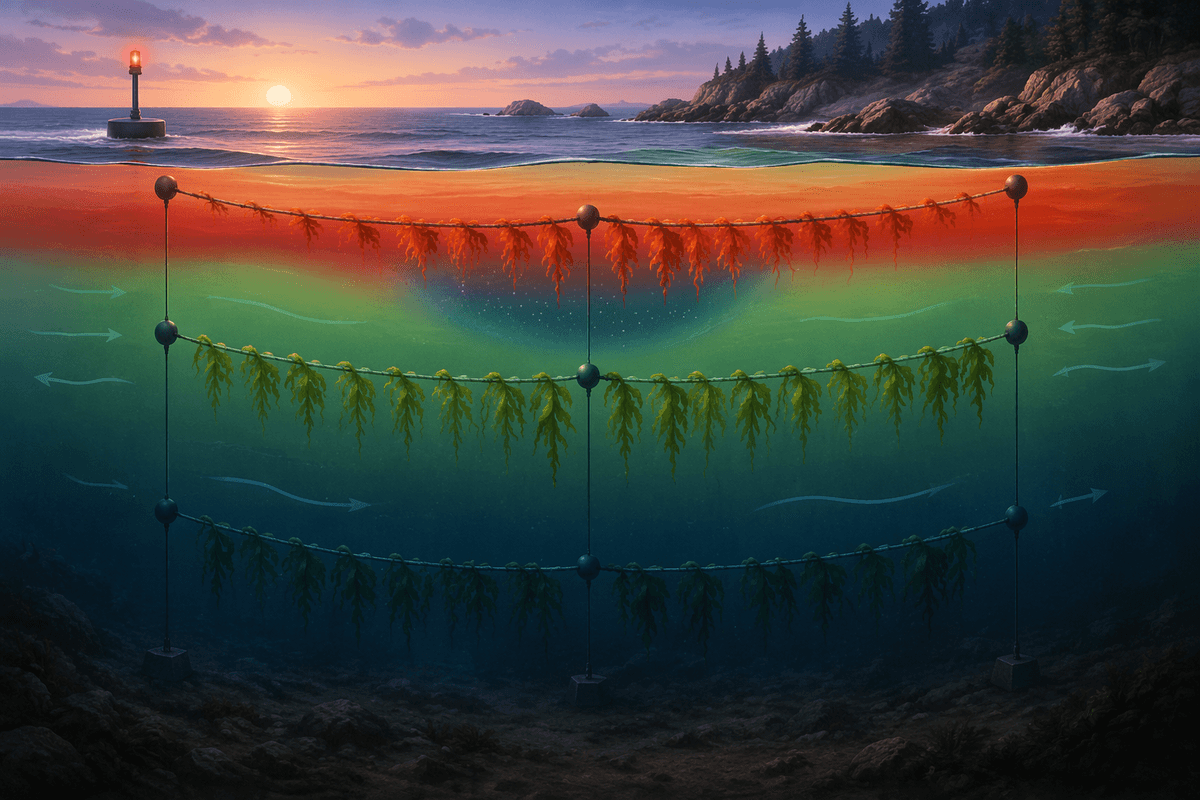
A familiar pattern on farms and wild beds is that problems arrive as “conditions” before they show up as “damage.” Water warms for several nights in a row, oxygen dips at dawn, turbidity stays high after runoff, or currents stall. Early warning models treat those shifts as leading indicators. They combine short-term forecasts (weather, swell, heatwave outlooks) with local sensor trends and recent imagery, then estimate a near-term risk score—less “your kelp is dying” and more “the next 5–10 days look like a high-stress window.”
The useful output is an actionable trigger: move lines deeper, harvest earlier, schedule inspections, or deploy extra cameras where models expect grazing pressure. Many coastlines have patchy sensor coverage, and models trained on one bay can misfire in another if currents, species mix, or farm gear differ. False alarms can waste boat time, but missed alarms can cost a crop, so teams usually start with conservative thresholds and tie alerts to quick, low-cost field checks.
Computer vision for disease, pests, and invasive species
When crews pull a line and see mottled tissue, pinholes, or a slimy film, the decision is usually whether this is normal variation, early disease, or something that will spread. Computer vision aims to standardize that judgment by scoring images for visible cues: bleaching patterns, lesion edges, grazing scars, epiphyte load, and changes in frond shape. In practice, the best inputs are consistent close-up photos from phones on a boat, fixed “photo stations,” or underwater cameras mounted to farm infrastructure.
Models are typically trained like a field guide that learns from examples: label photos as “healthy,” “suspected disease,” “urchin grazing,” or “invasive cover,” then let the system learn the visual signatures. Output can be simple—percent of frond area affected, counts of pests per frame, or a flag when an invasive species crosses a threshold that triggers removal.
Light, turbidity, and motion blur can create false positives, and new outbreaks may look different than the training set. Keeping accuracy high takes ongoing labeling time, periodic re-training, and camera cleaning—costs that need to be budgeted, not assumed away.
Using ML to guide restoration and farm operations
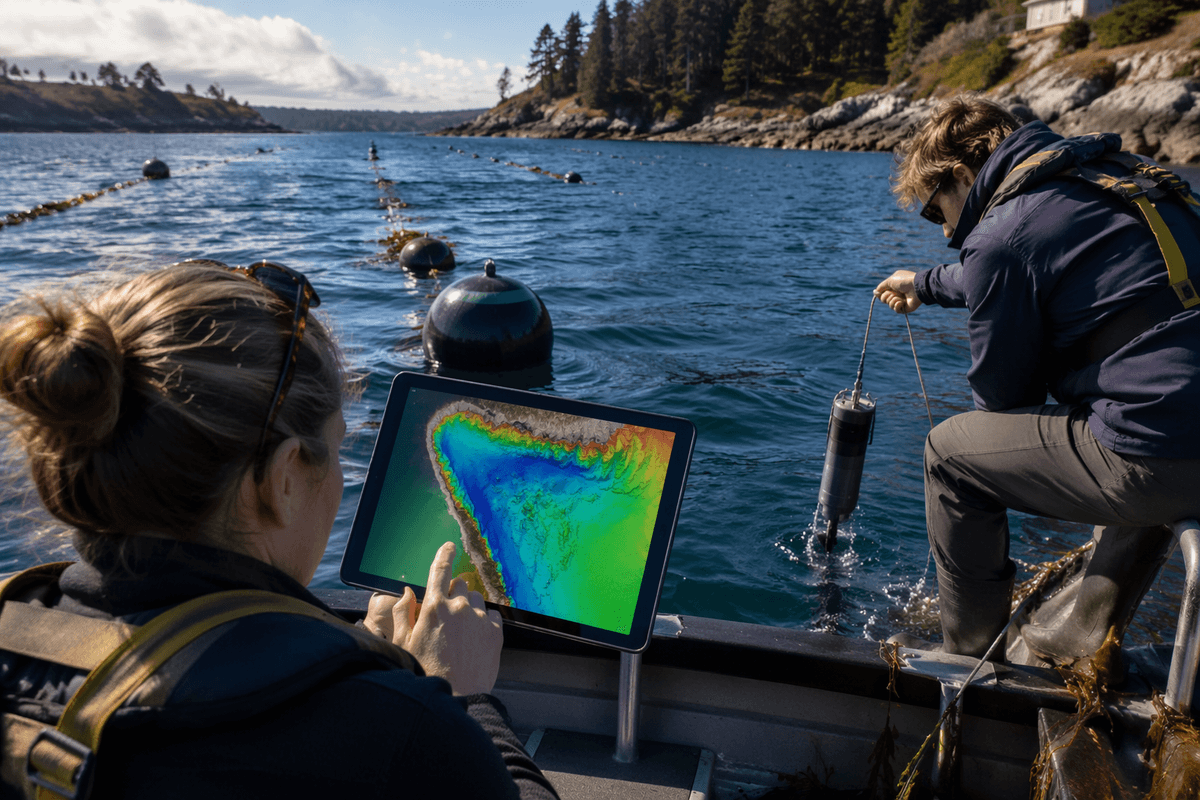
A restoration team deciding where to plant or a farm manager deciding where to set lines is making a bet on conditions they can’t fully see. ML can make that bet more informed by combining site history (survival and growth), exposure (waves, currents), and stress indicators (temperature spikes, low oxygen mornings, turbidity after rain) into a “where will this work now?” suitability map. For wild beds, the same approach can help prioritize patches likely to persist through the next warm season, so limited dive time and seed stock go to places with the highest expected payoff.
On farms, models can link operations data—seeding dates, depth, spacing, harvest weights, and loss notes—to environmental trends to recommend practical tweaks: shifting depth during heat stress, harvesting earlier ahead of fouling windows, or staggering seeding to reduce the chance that all lines hit peak vulnerability at once. These recommendations are only as reliable as the farm’s records and sensor upkeep; missing yield logs, inconsistent photo habits, or fouled probes can turn “optimization” into noise.
Deployment realities: trust, cost, governance, and community impacts
The farm crew or a coastal NGO usually doesn’t need a perfect model; they need a system they can trust when conditions get busy. That trust is built when alerts are legible (what triggered, how confident, what to check), when the model is tested against local “ground truth,” and when people can override it without penalty. Black-box scores with no explanation tend to get ignored after the first round of false alarms—especially when each check costs fuel, labor, and lost work time.
Costs show up in unglamorous places: sensor fouling and replacement, camera cleaning, data plans, field labeling, and someone’s hours to manage the pipeline. Satellites and drones may look cheap per image but can fail when clouds, turbidity, or permitting gets in the way. Many teams end up with a hybrid workflow: automation for screening, plus scheduled human checks to prevent models from drifting as seasons, species mixes, and gear change.
Who owns imagery from a farm lease? Can data be used for enforcement, insurance pricing, or lease decisions? Community impacts matter too: monitoring can protect livelihoods, but it can also shift power toward whoever controls the tools. Clear data-sharing agreements, privacy boundaries, and locally chosen success metrics reduce that risk.
A practical path: start small, prove value, scale carefully
A realistic starting point is one narrow decision with clear stakes: “Do we need to inspect this site this week?” or “Should we harvest early ahead of a stress window?” Pick one input stream you already trust (temperature loggers, weekly phone photos, or harvest weights) and define success in operational terms—fewer surprise losses, fewer wasted trips, or earlier detection of a specific issue. Run the model in “shadow mode” first, comparing alerts to what crews actually see, and track false alarms as a direct cost.
Scaling works best when the workflow stays simple: automate screening, require a quick field check for high-impact actions, and document what changed when alerts were followed. Add new data sources only when they reduce uncertainty, not because they are available. Budget for the ongoing work—cleaning sensors, labeling images, retraining models when seasons shift—and set governance rules before expansion, including who can access data and how it can be used.