Why “explainable” suddenly matters to your model’s success
A model can be accurate and still fail in the real world because the people using it can’t defend it. The moment a prediction affects pricing, credit limits, fraud holds, medical triage, or who gets reviewed by a human, someone has to explain “why this one” to a leader, a customer, or an auditor.
That pressure has increased as models move from dashboards into automated workflows. If the output can trigger an action, it can also trigger complaints, escalations, and regulatory questions—often on a deadline.
Explainability is also a build-and-ops issue. Without it, debugging becomes guesswork, drift is harder to diagnose, and you pay for slower iteration: more manual reviews, more reversals, and more time spent arguing about whether the model is “right” instead of improving it.
Who needs the explanation—and what decision will they make?
The first step isn’t picking a method; it’s naming the audience and the decision they’re trying to make with the explanation. A frontline reviewer deciding whether to override a fraud hold needs a clear, case-level reason they can act on, not a statistical tour of the training set. A product leader deciding whether to expand the model to a new segment needs a global view: what features matter overall, where performance breaks, and which groups see higher error rates. A compliance or risk team needs evidence the system follows policy constraints and that sensitive attributes aren’t being used in disguised ways.
Local explanations can be persuasive but unstable across small input changes, while global summaries can hide edge cases that trigger complaints. If you can’t state the decision in one sentence, you’re likely to ship an explanation that sounds good but doesn’t reduce risk.
Start with model choices that are easier to justify
A familiar failure pattern is reaching for the most accurate model first, then trying to bolt on explanations later. If you already know you’ll need to justify decisions to customers or auditors, start by considering model families that are easier to reason about: monotonic gradient-boosted trees for pricing and risk, generalized linear models for scorecards, or rule lists for eligibility checks. These can still perform well, and their constraints create a story you can defend: “higher utilization should never reduce risk,” or “missing income information increases uncertainty.”
The simpler or constrained models can leave accuracy on the table, and they may require more feature work to compete. But that cost is often lower than the operational cost of explaining a black box under pressure. When you do need complex models, treat interpretability as a requirement, not a slide: bake in constraints, calibrate outputs, and document what the model is allowed to learn.
Make the inputs human-readable before explaining the model
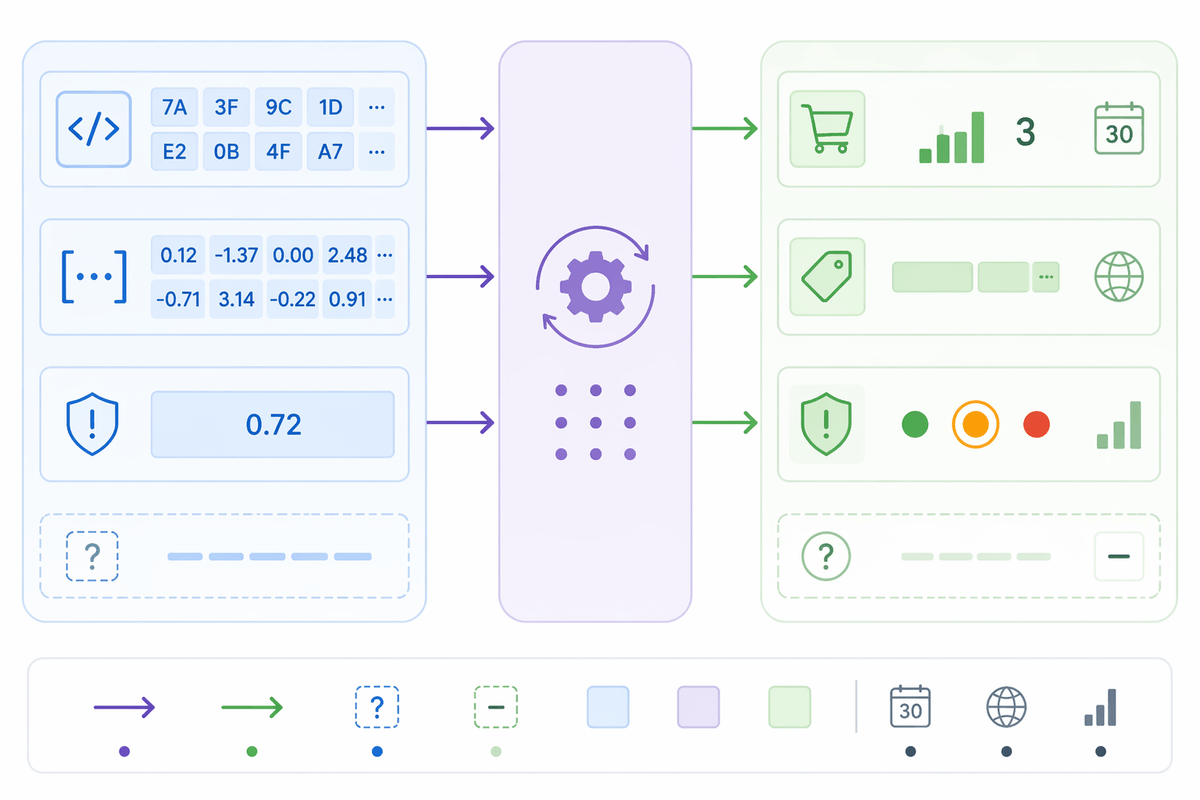
You can’t meaningfully explain a prediction if the inputs read like an export file. “txn_cnt_30d,” “mcc_5999,” and “device_risk_v3” might be fine for training, but they don’t support a conversation with an agent, a customer, or an auditor. Invest in a translation layer: plain-language feature names, units, and directionality (“number of chargebacks in last 30 days,” not “cb_30d”), plus definitions for missingness and defaults (“income unknown” versus “income = 0”).
Also make the inputs stable and reviewable. Bucket extreme values, surface the underlying raw fields, and track which upstream system produced each feature so disputes can be investigated. This work is unglamorous and costs time across data engineering and policy teams, but it prevents explanations from turning into a debate about what the model even saw.
Pick explanation methods that match the question you’re answering
A common mistake is treating “explainability” as one thing. The method should follow the question. If you need to understand overall behavior—what drives outcomes, where the model is brittle, or whether it’s leaning on proxies—use global tools: feature importance with clear definitions, partial dependence or ICE plots for directionality, and segment-level error analysis to show where the model breaks. These are better for roadmap decisions and risk reviews than a handful of cherry-picked examples.
If you need to justify a single decision—why this customer was declined or why this transaction was held—use local explanations such as SHAP-style attributions, counterfactuals (“if X were lower, the outcome changes”), or rule-based reason codes. Local attributions can flip with small input noise, counterfactuals can suggest unrealistic changes, and reason codes can oversimplify. Treat them as decision aids, not ground truth, and test whether different methods tell a consistent story on the same cases.
Don’t ship explanations you haven’t stress-tested

A familiar moment: a stakeholder asks for “the top reasons” behind a set of decisions, you generate nice-looking explanations, and everyone nods—until a customer complains and the explanation doesn’t match the case file. Explanations are a user-facing product surface, so they need the same hardening as the model. Start by checking stability: do the explanations change dramatically when you add small noise, slightly change a threshold, or rerun the method with a different background dataset? If they do, you’re not ready to present them as “reasons.”
Then probe for failure modes that make explanations misleading. Look for leakage features (“account_status_updated_after_decision”), correlated proxies (ZIP-like signals), and features that are technically valid but socially hard to defend (device type, employer name). Stress-test across slices where you expect trouble: new users, low-data profiles, edge geographies, and known dispute-heavy segments. This takes time and label review, and it may force feature changes or policy constraints, but it’s cheaper than explaining an explanation under escalation.
Finally, test explanations against human expectations. Give a small set of real cases to reviewers and ask whether the reasons are actionable, specific, and consistent with policy. If the explanation says “high risk due to utilization,” the reviewer should be able to verify the input and see how it maps to the decision rule or threshold. If they can’t, you don’t have explainability—you have decoration.
Turn explanations into something people can actually use
A usable explanation ends in an action, not a chart. For a case decision, that usually means a short set of policy-aligned reason codes plus the supporting facts the reviewer can verify (“3 chargebacks in 30 days,” “address mismatch,” “income missing”), and a clear confidence or uncertainty signal. For customers, the same content often needs a different wrapper: avoid raw feature names, avoid implying sensitive inference, and give a concrete next step (“update income documentation,” “retry after verifying device”).
Make explanations comparable and auditable. Standardize the format, cap the number of reasons, and keep a stable mapping from model signals to reason codes so two similar cases don’t get wildly different narratives. Store the explanation alongside the inputs, model version, thresholds, and any overrides, because disputes and audits happen weeks later. The more detail increases clarity for experts but raises privacy, legal, and UX risk if exposed too broadly.
A practical workflow for explainability that scales
On a real team, “doing explainability” has to look like a repeatable pipeline: define the decision and audience, freeze the policy constraints, and choose a small set of artifacts you’ll maintain (global behavior report, slice-based metrics, and a local reason-code template). Build explanations into evaluation by running them on a fixed case suite every model change, alongside calibration and fairness checks, so regressions are visible before launch.
Operationalize it with ownership and versioning. Treat feature definitions, thresholds, and reason-code mappings as governed assets; log them with the model version and input snapshot. Budget time for quarterly reviews because upstream data shifts will break both predictions and narratives, and the cost is usually analyst time: labeled case audits, dispute sampling, and stakeholder sign-off.